Why three cemented elements matter
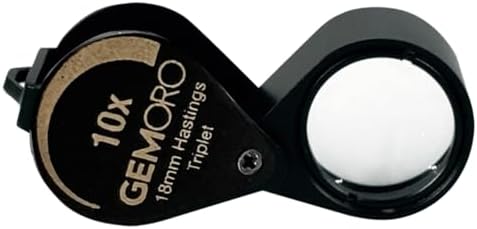
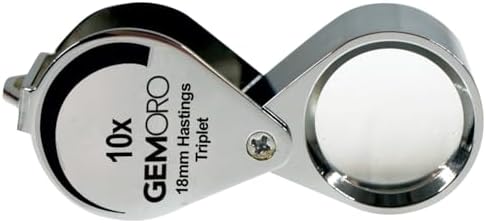
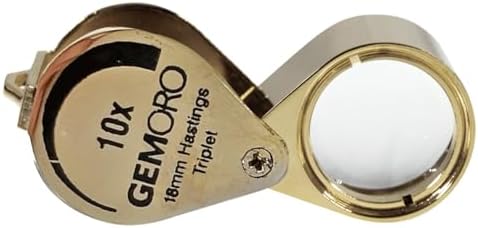
A single lens bends different wavelengths of light at different angles, creating color fringing around facet junctions. It also curves the focal plane, blurring the outer edges of the field. We build our triplet loupes with three separate optical glass lenses cemented together. Two outer meniscus elements correct chromatic aberration, while the center lens corrects spherical distortion. The result is an image that stays flat, sharp, and color-true from the center of the view all the way out to the metal rim.
The trade grading standard
Ten times magnification is the international benchmark for diamond grading and gemstone clarity assessment. If an inclusion is not visible under a properly corrected 10x lens, it does not exist for clarity grading purposes. Higher magnification reduces your field of view and cuts down depth of field dramatically. A 10x triplet gives the correct balance of magnification, light transmission, and working area to judge surface condition, inclusions, and mounting security without distorting proportion.
Anchoring the optic and focal distance
A 10x loupe has a focal length of roughly one inch. Beginners hold the lens out in the air near the gem and lean over it, which introduces handshake and neck strain. Hold the loupe between thumb and forefinger, open the housing, and press your knuckles or index finger firmly against your cheekbone just below your dominant eye. Keep the loupe stationary against your face. Use your other hand to bring the gemstone or ring up to that one-inch focal point.
Managing light and eye fatigue
Position your bench lamp above and slightly behind your shoulder, or off to the side, letting light strike the stone directly. Do not block the light path with your loupe hand or housing. Train yourself to keep both eyes open while looking through the lens. Squinting the non-viewing eye creates tension headaches and tires your facial muscles within minutes. Your brain quickly learns to ignore the secondary image from the open eye while you study the magnified stone.
First passes across the stone
Begin your inspection at the girdle edge and facet junctions before searching deep into the table. Look for chips along the girdle, naturals, open feathers, and worn facet junctions that show abrasion. Check the prong tips and bezel edges to confirm the setting holds the stone tight without gaps. Once the exterior surfaces and setting integrity are verified, focus inward through the table facet to map internal crystals, clouds, needles, or cleavages layer by layer.
Built for the bench
We assemble our triplet loupes with corrected optical glass housed in solid metal bodies to handle daily bench use. Learning to anchor the frame against your cheekbone and move the stone turns a jumpy image into a steady, repeatable inspection. Clean the lenses only with optical cloths to protect the coatings and keep your field of view clear.